Your friends keep telling you to sell your sourdough. The baking is the easy part; what stops most people is the moment a hobby becomes a business, with filings, fees, and a pickup day that has to actually work. I build ordering software for home bakers, so I spend a lot of time inside this exact month.
Here is the plan we hand to bakers who ask: four weeks in a set order, each with a budget line and a pass/fail test. Week 1 makes it legal. Week 2 prices the menu and sets up payment. Week 3 runs a first drop to 10 to 15 people. Week 4 is your first pickup day. Done in order, the month costs a few hundred dollars, and you collect payment before you preheat the oven.
Key takeaways
- Cottage food sales are legal in all 50 states; the three example states' annual caps run from $75,000 for California Class A to $250,000 in Florida.
- The month runs in order: week 1 files the paperwork (under $300 registration, $0 tax ID), week 2 prices from a cost floor, week 3 drops to 10 to 15 prepaid orders, week 4 is the first pickup day.
- Cost-floor math prices a sourdough loaf at $16 while the September 18, 2026 median across 172 real marketplace listings was $12; price from the floor, not the market.
- Payment at the order, not at pickup, is the reported fix for no-shows; where full prepay feels stiff, reported deposits run 25 to 50% of the total.
- Reported startup totals span roughly 30x: one first-timer's first month ran $120 to $450 and lean tiers assuming an owned oven run $340 to $500.
Is it legal to sell baked goods from home?
Yes: all fifty states allow at least some cottage food sales, meaning low-risk foods like baked goods, jams, granola, and candy made in a home kitchen. The laws vary widely and keep moving; many states have updated theirs in the last few years. The first question is which regime your state runs; three states show the spectrum.
Florida asks for almost nothing. Cottage food operators there sell approved foods directly to consumers with no food permit from the state. Gross sales are capped at $250,000 a year, and you can sell on your own website, by mail order, or in person; wholesale is off the table.
Texas forbids permits but still assigns homework. Local health departments cannot require a Texas cottage food operation to hold any license or permit or pay any fee for direct sales. Since September 1, 2025, the annual gross income cap is $150,000 under SB 541. Every operator must complete an accredited basic food-handler training program before operating, and selling time-and-temperature-controlled foods requires a DSHS registration plus specific labeling and handling rules. Online orders are allowed only when you, an employee, or a household member hand-delivers the food. And every label must carry the operation name, an address or DSHS registry ID, the product name, any major allergens, and the exact disclosure "THIS PRODUCT WAS PRODUCED IN A PRIVATE RESIDENCE THAT IS NOT SUBJECT TO GOVERNMENTAL LICENSING OR INSPECTION."
California makes you register first. A Class A operation registers with the county environmental health department and files a self-certification checklist before opening; Class B requires a permit issued after an initial inspection. The statutory caps are $75,000 for Class A and $150,000 for Class B, adjusted upward for inflation each year, so the real 2026 limits sit higher. Operators complete a Cottage Food Operator Training within three months of registering or being permitted.
Cottage food sales caps run from $75,000 to $250,000 a year
View data
| state | Annual gross sales cap (USD) (USD) |
|---|---|
| California Class A (base, CPI-adjusted) | $75,000 |
| Texas (SB 541, eff. Sept 1, 2025) | $150,000 |
| California Class B (base, CPI-adjusted) | $150,000 |
| Florida | $250,000 |
Your state sits on this spectrum. Pull up your state agriculture or health department page and write down four things: what you must file, the sales cap, which foods are allowed, and the exact label text. Our guides for Texas, Florida, and California keep the current versions. That four-line list is week 1.
Week 1: file the paperwork and pick a tiny menu
Budget this week: under $300 for registration, $0 for the tax ID, plus $50 to $90 of day-one gear. Done when: you know whether your state registers, permits, or asks for nothing, and you have filed it.
The SBA's launch order doubles as the week-1 order: location and zoning, business structure, business name, registration, tax IDs, licenses and permits, a business bank account, insurance last.
- Zoning. Zoning rules are local and can apply even to a home-based business. A short call to your city or county planning desk tells you whether a Saturday porch pickup is an issue before your neighbors do.
- Name and registration. Sell under your own legal name and you usually file nothing; use a business name and most states require a DBA registration. Total registration cost runs under $300 in most cases, varying by state and structure.
- Tax ID. An EIN is free from the IRS and issued immediately. Never pay a website for one.
- Training. Where your state requires it, as Texas and California both do, it is an accredited food-handler course, not a culinary program.
- Bank account. A separate account keeps business money out of your grocery budget and makes tax season readable.
- Insurance. Your state's cottage food law may not require it; venues and farmers markets often do, and federal law mandates specific coverage only once you have employees. Homeowners and renters policies typically exclude business losses and often cap business equipment replacement at $2,500, per 2018 NAIC guidance. A cottage food liability policy from FLIP starts at $299 a year for $2 million aggregate and $1 million per-occurrence general liability plus $2 million product liability. Decide this week; buy it when a venue asks.
For gear, vendor checklists report that most home cooks already own about 80 percent of what a food business needs and put day-one purchases at $50 to $90 total. Buy nothing else until a real drop tells you what runs out first.
| Reported day-one purchase | Reported price |
|---|---|
| Food thermometer | $15 to $25 |
| Digital scale (11 lb+, tare) | $15 to $30 |
| Extra sheet pan | $10 to $15 |
| Cooling rack | $10 to $20 |
| Day-one total | $50 to $90 |
Then the menu, and it stays tiny. Reported drop practice caps a menu at three to five items per drop, or five to eight per week anchored by three staples that appear every time. Your first menu is the short list of things people already ask for. Write it down; that is the deliverable.
Week 2: price from a cost floor, then set up how you get paid
Budget this week: your first month of packaging, reportedly $80 to $150 for an active home bakery, plus the per-order payment fees below. Done when: every menu item has a price built up from costs, and you can name what each payment rail charges you.
University of Maine extension guidance tests every price three ways: it must cover total costs plus a reasonable profit, stay competitive with similar products, and sit inside what your buyers will pay. The same bulletin runs one worked example four ways. With 5 units, $30 of materials, 10 hours of labor at $10 an hour, and $20 of overhead, a materials-times-three formula prices each unit at $18, a beginner break-even formula at $26, a wholesale formula at $32, and the full individualized formula at $42. Spread across one recipe, that is the difference between covering your flour and covering your Saturday.
A 50% markup on cost is only a 33.3% margin; to hold a 40% margin on a $1.00 cost you price at $1.66, not $1.40. And most bakers reportedly undercharge. One vendor's worked sourdough loaf lands at a $13.38 cost floor and a suggested $16 after a 20% margin, while most bakers reportedly charge $10 to $12. In a September 18, 2026 pull of 172 full-size sourdough listings on the Homegrown marketplace, the median price was $12: $10 for plain loaves, $13 for flavored, $14.50 for whole-grain. The formula says $16 and the market median says $12. Price from the floor.
Real sourdough medians top out at $14.50 a loaf
View data
| loafType | Median price (USD) (USD) |
|---|---|
| Plain | $10 |
| Sandwich | $11 |
| Flavored | $13 |
| Whole grain / rye / spelt / einkorn | $14.5 |
| All full-size loaves | $12 |
For a sanity check, a 2026 pricing guide reports "profitable" ranges in mid-cost-of-living markets: cupcakes $36 to $60 a dozen, decorated sugar cookies $48 to $72 a dozen, a 9-inch two-layer cake $55 to $85, quick bread $12 to $18, sourdough $10 to $15, fruit pie $25 to $40. Its rules of thumb: ingredients at no more than 25 to 35% of the selling price, labor at a minimum of $20 to $35 an hour, and overhead adding 10 to 15%. These are reported ranges, so let your cost floor win any disagreement. Reported signals that you are priced about right: 5 to 15% of quotes get declined, and you net at least 60 to 70% gross margin on most items. Our free Recipe Cost Calculator does the per-batch math.
Then decide how money moves; each rail takes a different cut. Rates are from the providers' fee pages, accessed September 2026.
| How the customer pays | Seller fee per transaction |
|---|---|
| Venmo business profile | 1.9% + $0.10 |
| Venmo Tap to Pay (business profile) | 2.29% + $0.09 |
| Venmo personal profile, sender marks "goods and services" | 2.99% |
| Venmo through PayPal online checkout | 3.49% + $0.49 |
| PayPal online checkout (cards) | 2.99% + $0.49 |
| PayPal Expanded Checkout (cards) | 2.89% + $0.29 |
| PayPal in-person (card present or QR) | 2.29% + $0.09 |
| Square online or invoice, free plan | 3.3% + $0.30 |
| Square in-person, free plan | 2.6% + $0.15 |
| Stripe online (domestic cards) | 2.9% + $0.30 |
Venmo's FAQ says personal accounts are meant for payments between friends and family; using one for sales can risk account limits. The business profile is the intended route and carries a lower percentage (1.9% versus 2.99%) plus a dime per transaction. Moving Venmo money to your bank is free on the standard 1 to 3 business day transfer, while Instant Transfer costs 1.75% with a $0.25 minimum and a $25 maximum. Square's online rate drops to 2.9% + $0.30 on its paid tiers, which matters only once you are paying Square monthly anyway. If you want to take cards in person, PayPal's first card reader runs $29. We could not verify current Cash App for Business or Zelle seller fees at publish time; check the providers before listing them.
Week 3: run a first menu drop to 10 to 15 people
Budget this week: $0. The channels are free. Done when: 10 to 15 orders sit prepaid, with a hard cutoff.
Vendor guidance sizes a first drop at 10 to 15 orders: big enough to feel like a business, small enough that nothing breaks. That cap exists because informal ordering reportedly starts failing around fifteen orders a week; below it, DMs plus a spreadsheet are survivable, and above it, orders get lost. Once 10 to 15 runs smoothly for a month, reported practice is to add 5 to 10 a week.
Where do the first 15 come from? Your own channels. In an interview published by its ordering platform, Warrenville Bread described starting with a single post to a local Facebook group after getting licensed: "I love to bake. Is anybody interested in fresh sourdough?" That post grew into a six-figure microbakery that packs 50 to 60 hand-labeled bags on busy weeks. A text or email list of 30 to 50 people getting a weekly "menu is live" message reportedly fills slots consistently, and texts are reported to carry the highest open rate of any channel. Bite Club, an apartment-kitchen bakery in Stamford, Connecticut, has run about 30 orders per drop since June 2026, with roughly 80% of items selling out within 24 hours and pre-orders open Tuesday through Thursday for a Saturday pickup. A different model works too: the Little Orange Cart, a walk-up front-lawn bakery in Edgewater, Maryland, sold out within hours on its August 29, 2026 opening weekend.
Cap the menu at three to five items and close orders at least 24 to 48 hours before pickup, so bake day is a list and not a guess. Give orders one place to land: one form, one payment link, one automatic confirmation. A Google Form with a weekly deadline reportedly works at low volume; fewer landing spots mean fewer lost orders. A real shop earns its keep here too: a free Batch52 Standard plan gives you a hosted shop with online ordering, pickup windows with lead times, and card or invoice payment, the same one-link-one-confirmation shape without the spreadsheet. (I build Batch52, so weigh that accordingly.)
And collect the money when the order is placed, not at pickup. Vendor guides put it bluntly: "a customer who will pay at pickup is an estimate, not an order." If full prepay feels stiff for a custom cake, reported deposit practice is 25 to 50% of the total, or 50% for custom and large orders; anything under 20% reportedly fails to deter no-shows.
Week 4: survive your first pickup day
Budget this week: bags, labels, and a folding table, most of it inside the packaging line you already bought. Done when: every order leaves labeled and paid for, or a written forfeiture policy covers the ones that do not.
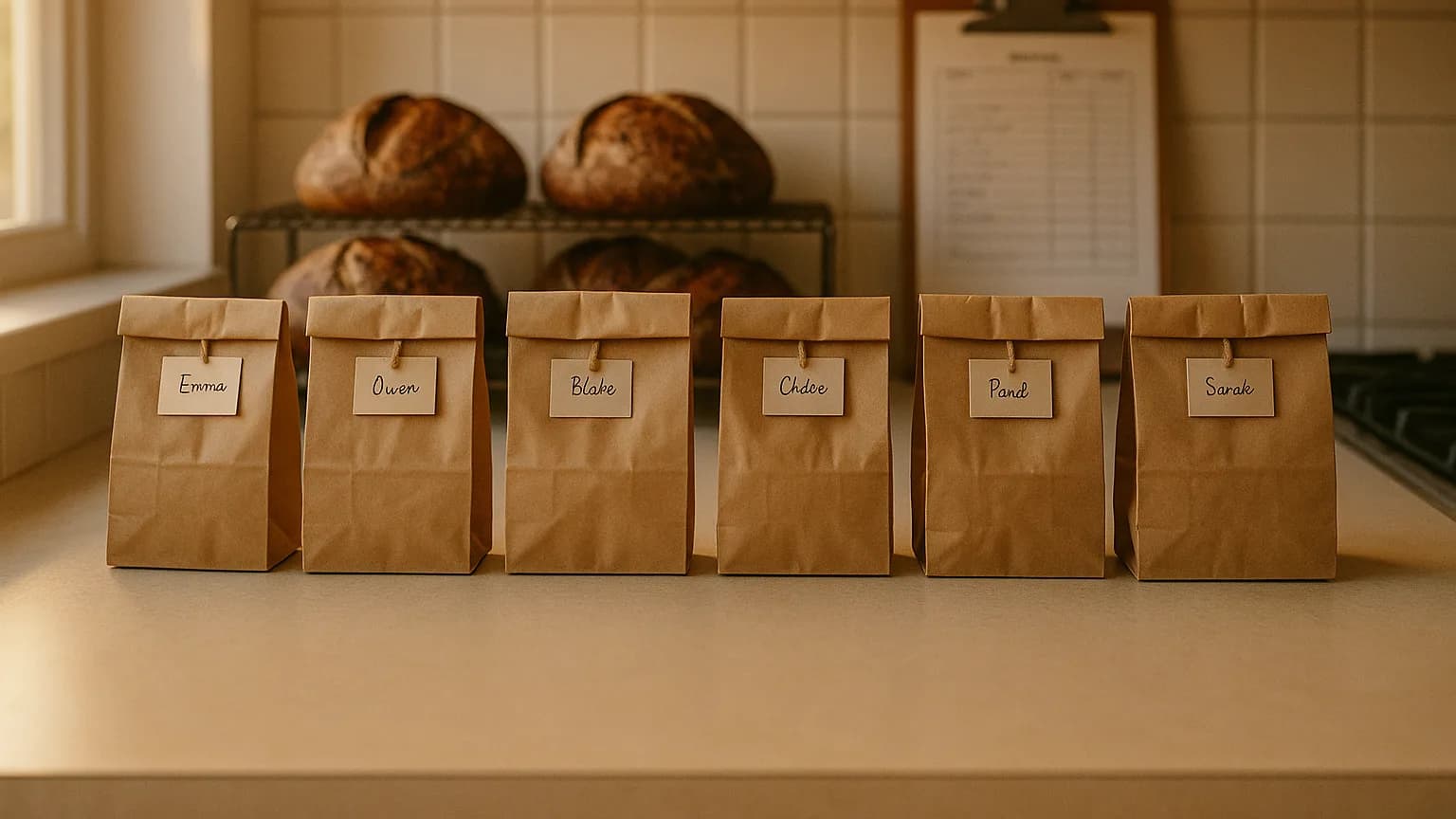
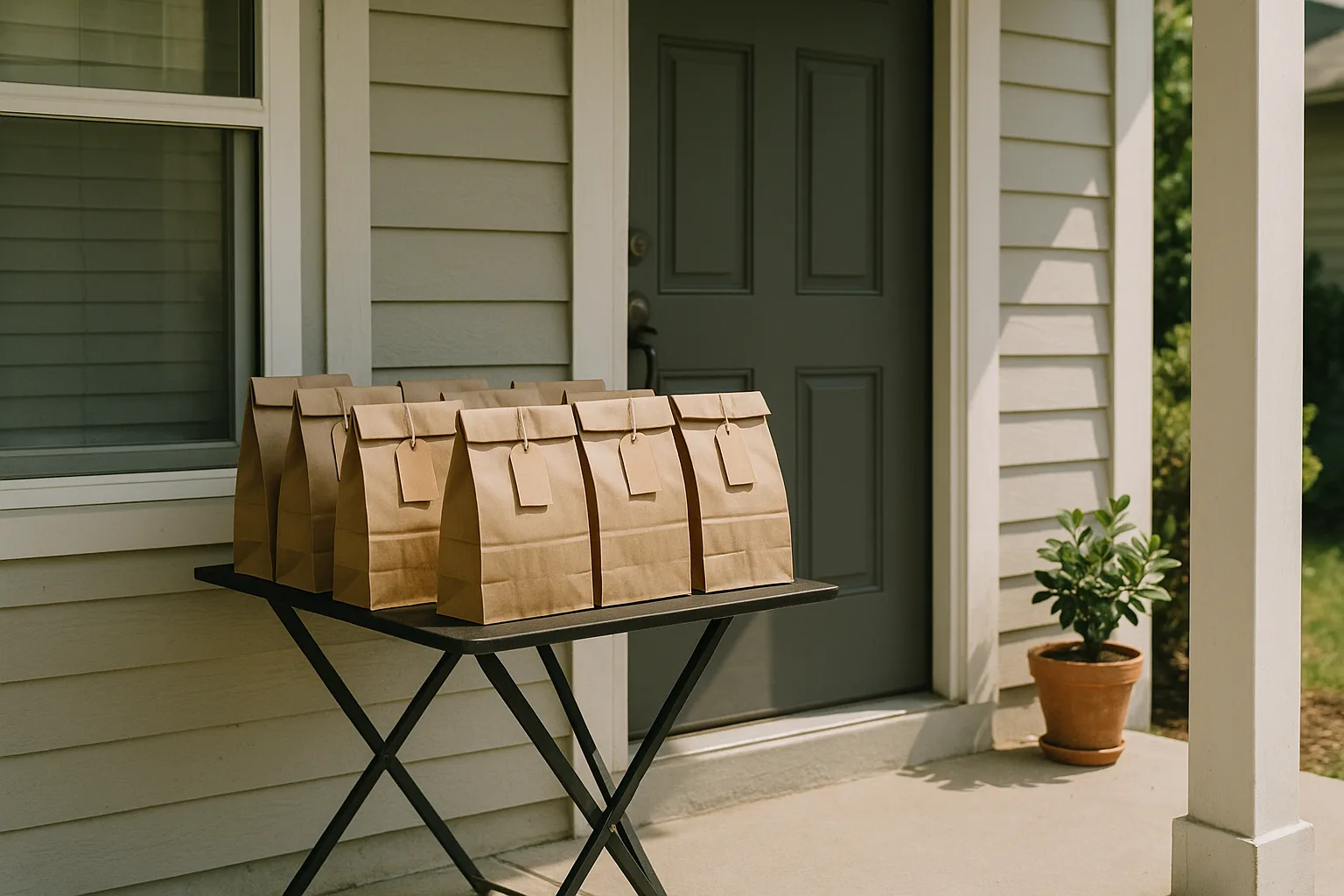
Set a pickup window of two to three hours. Reported practice is a porch or garage table, bags labeled and sorted alphabetically, set up 15 to 30 minutes before the window opens. When a seller is consistently running 30 or more orders per drop and street parking becomes a problem, vendor guidance says to move pickup off-site. A good problem, and not this week's.
In a cottage food Facebook thread on porch-pickup security, the visible consensus (we saw only part of the thread) was to carry liability coverage that explicitly covers porch pickup and to use cameras or a controlled, text-on-arrival handoff rather than an open cooler on a busy road.
Plan for the person who does not come. One vendor's example: 15 orders, 12 pickups, $60 of cinnamon rolls left on the counter; a no-show rate above 10% reportedly calls for deposits. Because you already collected payment, a no-show leaves you with inventory, not lost revenue. Written policies reported across drop guides: hold unclaimed orders until end of day, then forfeit without refund; full refund for cancellations before the order deadline, none after; no changes to an order after the deadline. Post them next to the menu so nobody meets them for the first time on your porch.
How much does it cost to start a home bakery?
Once the weekly lines roll together, a lean launch is in the low hundreds. Reported startup totals vary roughly 30x, depending on what each writer assumes you already own and whether insurance, a mixer, and branding get counted. One real first-timer's first month reportedly ran $120 to $450; lean tiers that assume an owned oven and pans run $340 to $500; a "typical" cottage food startup $550 to $1,750; standard tiers $1,400 to $1,600; pro tiers $3,200 to $3,700. A farmers-market route instead of porch pickup reportedly runs $600 to $1,050, with booth fees of $20 to $75 a week, and first-time vendors reportedly underestimate their total costs by 30 to 50%.
| Reported scenario | Reported total |
|---|---|
| One real first-timer's first month | $120 to $450 |
| Lean tier (owned oven and pans) | $340 to $500 |
| Typical cottage food startup | $550 to $1,750 |
| Farmers-market vending startup | $600 to $1,050 |
| Standard tier | $1,400 to $1,600 |
| Pro tier | $3,200 to $3,700 |
The SBA's method for checking any of these numbers: split costs into one-time and monthly, count at least a year of monthly expenses, and add about a 10% buffer for the unpredictable. The monthly lines first-time budgets miss are packaging (reportedly $80 to $150 a month) and the payment fees from the week 2 table. One honest warning from University of California extension guidance: you probably will not be profitable during your first few months, especially if you front-load equipment. That is the argument for the $15 thermometer and the oven you already own.
After day 30: fix the leaks, then the paperwork
The most-reported causes of inconsistent weekly orders read like a normal first month: no ordering system, too many menu options, inconsistent posting, no repeat-customer strategy, and underpricing. The reported first fixes map to those one-to-one: a single order channel, automatic confirmations, prepay at order, per-item capacity caps, written policies, and a weekly 15-minute numbers review covering orders, revenue, cost of goods, profit per item, and new versus repeat customers.
Tax paperwork gets urgent once volume does. Under the One Big Beautiful Bill (P.L. 119-21), payment apps and online marketplaces file a Form 1099-K only when your gross payments exceed $20,000 and your transaction count exceeds 200; both conditions must be true. Direct card processors are different: if customers pay you by credit, debit, or gift card, the processor sends a 1099-K no matter the amount or the count. And whether or not any form shows up, all of the income goes on your return.
So does being findable. Once strangers want to order, a Google Business Profile is one way they find your pickup address and hours. Home bakeries hit quirks there that need their own walkthrough, so we wrote one: our GBP guide for cottage food sellers.
None of that is this month's problem. This month's problem is one honest sentence on a Facebook group post and 15 people who say yes. Week 1 starts tonight: open your state's cottage food page and find the four lines from the first section.
Sources
All sources accessed September 2026.
- Cottage Foods and Home Kitchens (Harvard Food Law and Policy Clinic). https://chlpi.org/project/cottage-foods/
- Cottage Foods (Florida Department of Agriculture and Consumer Services). https://www.fdacs.gov/Business-Services/Food-Establishments/Cottage-Foods
- Texas Cottage Food Production (Texas Department of State Health Services). https://www.dshs.texas.gov/retail-food-establishments/texas-cottage-food-production
- Cottage Food Operations (California Department of Public Health). https://www.cdph.ca.gov/Programs/CEH/DFDCS/Pages/FDBPrograms/FoodSafetyProgram/CottageFoodOperations.aspx
- Launch your business (U.S. Small Business Administration). https://www.sba.gov/business-guide/launch-your-business/get-federal-state-tax-id-numbers
- Cottage Food Insurance (Food Liability Insurance Program). https://www.fliprogram.com/cottage-food-law-insurance
- Working from Home and Your Insurance Coverage (NAIC Consumer Insight, 2018). https://content.naic.org/article/consumer-insight-working-home-your-insurance-coverage
- When to Buy Equipment for Your Food Business (Homegrown). https://findhomegrown.com/blog/equipment-for-home-food-business
- How to Run a Weekly Food Drop (Homegrown). https://findhomegrown.com/blog/how-to-run-weekly-food-drop
- How to Get Consistent Weekly Orders for Your Home Bakery (BakingSubs). https://www.bakingsubs.com/blog/how-to-get-consistent-weekly-orders-home-bakery
- How to Take Pre-Orders for Your Home Bakery (MyPorch). https://myporch.app/blog/how-to-take-pre-orders-for-home-bakery
- How Much Does It Cost to Start a Home Bakery (Baker Setup). https://www.bakersetup.com/blog/how-much-does-it-cost-to-start-a-home-bakery
- Bulletin 3000, Basic Pricing Strategies for Small Businesses (University of Maine Cooperative Extension). https://extension.umaine.edu/publications/3000e/
- How to Start a Home Bakery in 2026 (MyPorch). https://myporch.app/blog/how-to-start-a-home-bakery
- How Much Should You Sell Sourdough For, 2026 Pricing Guide (Homegrown). https://findhomegrown.com/blog/how-much-to-sell-sourdough-for
- How to Price Baked Goods for a Home Bakery, 2026 Formula and Market Rates (Home Business Hub). https://www.homebusinesshub.us/blog/how-to-price-baked-goods-for-a-home-bakery/
- Venmo Fees (official fee schedule). https://venmo.com/legal/fees/
- PayPal Business Fees, US (official). https://www.paypal.com/us/business/fees
- Venmo for Business, Accept Venmo Payments (PayPal). https://www.paypal.com/us/business/accept-payments/accept-venmo
- Square Payments, Our Fees (official). https://squareup.com/us/en/payments/our-fees
- Stripe Pricing (official). https://stripe.com/pricing
- How a Danish Baker in New Jersey Built a Six Figure Microbakery (Hotplate). https://www.blog.hotplate.com/blog/how-a-danish-baker-in-new-jersey-built-a-six-figure-microbakery
- Connecticut's 'Bite Club' is selling out of sourdough (New Haven Register). https://www.nhregister.com/business/article/bite-club-stamford-sourdough-22386592.php
- A Bet With Her Husband Turned Into Edgewater's Newest Baking Sensation (Patch). https://patch.com/maryland/edgewater/little-orange-cart-becomes-hit-bakery-anne-arundel-county
- Should You Take Deposits, A Guide for Home Bakers (OrderPost). https://www.orderpost.store/blog/deposit-strategy-home-bakers
- Facebook group discussion, January 2025 (paraphrased).
- How Much Does It Cost to Start a Micro Bakery From Home (Micro Bakery Girl). https://microbakerygirl.com/cost-to-start-micro-bakery/
- The Real Cost of Selling at Farmers Markets (Homegrown). https://findhomegrown.com/blog/the-real-cost-of-selling-at-farmers-markets
- Calculate your startup costs (U.S. Small Business Administration). https://www.sba.gov/business-guide/plan-your-business/calculate-your-startup-costs
- Cash Flow and Profitability, Minding Your Dollars and Cents (UC ANR Cottage Foods). https://ucanr.edu/site/cottage-foods/cash-flow-profitability-minding-your-dollars-and-cents
- IRS issues FAQs on Form 1099-K threshold under the One Big Beautiful Bill, IR-2025-107 (IRS). https://www.irs.gov/newsroom/irs-issues-faqs-on-form-1099-k-threshold-under-the-one-big-beautiful-bill-dollar-limit-reverts-to-20000
- Understanding your Form 1099-K (IRS). https://www.irs.gov/businesses/understanding-your-form-1099-k
Frequently asked questions
Do I need a license or permit to sell baked goods from home?
It depends on your state. Florida requires no food permit at all, Texas forbids local governments from requiring one but still mandates an accredited food-handler course, and California requires registration for a Class A operation or a permit for Class B. Check your own state's cottage food page first.
Can I sell cottage food online or by mail order?
It depends on the state. Florida expressly allows sales on your own website, by mail order, and in person, while Texas allows online orders only when you, an employee, or a household member hand-delivers the food. No source we read settles interstate shipping, so treat it as a state-by-state question.
Will a new home bakery be profitable in the first month?
Probably not. University of California extension guidance warns new cottage food operators they will likely not be profitable during their first few months, especially after front-loading equipment. That is the case for the $15 thermometer and the oven you already own.

Nicholas Shiffert
Founder, Batch52
Nicholas builds Batch52, the ordering platform for home bakers and cottage food businesses. He spends most weeks talking with bakers about pickup days, pricing, and the paperwork nobody warned them about.
Research and drafting assisted by AI. Fact-checked, edited, and published by Nicholas Shiffert.